
About Photovoltaics
Overview
Rather than having just a handful of ageing and polluting power stations we now have the possibility of decentralisation; millions of small generators producing power where it is needed, solving the problem of large energy losses during transmission.
Although photovoltaics work better in direct sunlight, they are not reliant on it. They only need daylight to produce electricity.
PV's are silent and unobtrusive, they are designed to withstand the elements and weather very little with age.
PV's have no moving parts and are very reliable. Most PV modules are guaranteed for 20/25 years, with a life expectancy far exceeding this. Maintenance requirements are negligible.
Solar PV produces electricity, not hot water. Please contact your local solar thermal installer for information on hot water systems.
Terminology
Module
A PV (photovoltaic) panel, which is made up of a number of 'cells', each of which produces a small electrical charge under light.
kWp (kilo-watt peak)
The number of thousand watts a photovoltaic system will produce in peak conditions.
kWh (kilo watt hours)
A unit of electricity. This is defined as power of 1000 watts (being consumed or produced) over the period of one hour. e.g. 2000w over 1/2 hour or 100w over 10 hours.
For example:
A PV module could have a rating of 300 Wp (produces 300 watts in peak conditions). 12 modules are connected together on a roof to form a 3.6 kWp array (300 * 12 = 3600 Wp or 3.6kWp). This array might generate 3.6 * 858 = 3089kWh / year (See 'electricity produced' below).
Module Types and Efficiency
Solstice Energy can supply and install any PV module accredited for use in the UK. If you have a particular requirement or preference for any reason please let us know.
People often confuse efficiency with quality, but all it means is that high efficiency modules can generate the same amount of power as lower efficiency modules in a smaller area. For example, 365Wp LG high efficiency modules are almost the same dimensions as 275Wp JA Solar polycrystalline modules. Our design team tends to recommend the (proportionally more expensive) high efficiency modules for smaller roof areas or where a client really wants to maximise output, and less expensive polycrystalline modules for large roof areas.
Quality and guarantee periods are similarly high with all the common tier 1 brands available for use in the UK.
Electricity Produced
Daylight levels in the UK mean that PV will produce an average of 858 kWh of electricity per kWp system size, per year (South-facing & un-shaded). Our output predictions are based on MCS (Microgeneration Certification Scheme) methodology and are shown on pg3 of our quotes.
An average UK household uses around 3000 kWh per year (so a 1kWp system would supply a quarter of the yearly use). Simple energy efficiency measures in the building will increase the proportion of energy coming from the PV's.
Roof Suitability
Positioning
The PV array will usually be mounted on a Southerly facing, pitched roof.
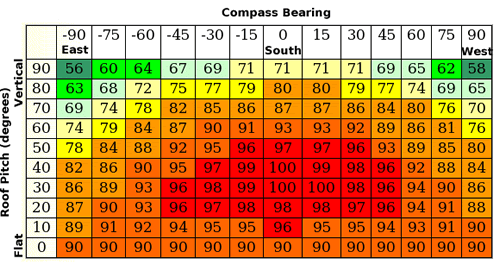
The "solar sundial" below shows that a fair bit of deviation in the positioning of the array will still yield a large percentage of the energy expected from an optimum orientation (a pitch of 30/40 degrees facing due South).
Shading
Whenever shading decreases the power output of any one module in an array, then the output of the whole array is similarly decreased. It is therefore very important to avoid shading (from trees, other buildings etc) when siting a PV array. However, if, for example, the shading only occurs late on winter afternoons then it will have less impact on the annual output of the array than shading that occurs every morning until 12:00.
For complicated shading situations, our designers can plot the PV array and the surrounding objects and run a PVSYST simulation to show predicted output throughout the year.
Roof Area Required
Allow approximately 6m2 of pitched roof area (9m2 of flat roof) for every 1kWp of PV. Obstructions like dormer windows and roof vents need to be considered when surveying the site. On flat roofs we need to consider parapet wall heights, mechanical ventilation plant, and also high wind edge zones.
Planning Permission
Planning permission is not normally required unless it is a listed building or in a conservation area - please see the Town and Country Planning Amendment of April 2008. If in doubt, check with your local council, and if you do need to make a planning application we will advise you and supply all the drawings, photographs etc that you need for a successful outcome.
Where Does It Go?
There are two ways of storing the electrical energy produced by a photovoltaic array. One is by using batteries and the other is by connecting to the national grid.
In a grid connect system, the grid works in effect as a battery. During the day the PV array might produce more energy than is required by the building it serves. This excess will be exported to the building next door or down the road via the mains. In the evening, or any other time of high use / low sun, electricity is drawn in the usual way from the grid, and supplemented by the PV system. This all happens automatically due to natural ebb and flow of electricity as it finds the shortest route to a load. Grid-connect PV is often referred to as 'fit and forget' because of the lack of user interaction or maintenance required.
Power Cuts
If there is a power-cut the inverter will shut the system down, and there will be no generation. This is a safety mechanism to avoid 'islanding' - where workers on a supposedly dead grid might get a shock from PV systems in the area exporting power. Power cuts are thankfully few and far between in the UK at the moment, but there are hybrid grid / battery systems available now which will continue to provide power to certain circuits in the event of a power cut.
G98 / G99 Regulations
G98 (replacing G83) regulations deal with the export of power below a maximum of 16A per phase, and cover most domestic systems. Under G83 we can install a system and notify the DNO (District Network Operator) afterwards
If we multiply 16A by 230volts you’ll see the maximum system size is 3.68kW. However, we can install up to 4kW under G83, which is the point at which the best economies of scale meet the highest Feed in Tariff, by under-sizing the inverter i.e. installing an inverter that limits the maximum a.c. output to <3.68kW. Under-sizing the inverter is normal practice anyway, and is explained further here.
If a building has a three-phase electrical supply then we have three times as much capacity under G98 regs, so we can install up to 11.04kW (perhaps 12kW with inverter under-sizing) without the need for an application to the DNO, as long as the system is divided so that it is <16A on each phase.
Tip: the easiest way of telling if you have single or three / phase electrics in your building is to check the number of wires connected at the bottom of the electricity meter. Single phase = 4 (1 live in, 1 live out, 1 neutral in and 1 neutral out). Three phase = 8 (3 lives in, 3 lives out, 1 neutral in and 1 neutral out).
G99: (replacing G59) regulations deal with systems above 16A / phase we need to apply for permission from the DNO. Most inverters have built in safety features that satisfy these regs, and so you don’t need a separate safety relay, contrary to popular belief. However sometimes there may be a requirement for the DNO to upgrade the local transformer (and charge for it) prior to connection so that it can safely handle the amount of power being fed into grid. This depends on the size of the system and also the location, and becomes more of an issue in rural areas ‘at the end of the line’. It is also possible that the DNO will ask for export limitation equipment to be installed as part of the system. In our experience, most systems under 50kWp get approved without any extra requirements but it’s always best to get that application in early during the design stage so everyone is certain about this.